Thursday, 11 November 2010
Tuesday, 9 November 2010
King Kong 1933
King Kong is an action adventure monster flick from 1933 about a director, Carl Denham (Robert Armstrong), and his film crew’s accidental encounter with a giant gorilla. Although all the action begins on the secluded Skull Island, the first scenes are set in New York, where Carl is looking for an actress to play the lead in his new project which will be shot on a mysterious island near Singapore. A young blonde, Ann Darrow (Fay Wray), catches Carl’s eye when she steals an apple from a grocer. He approaches Ann and offers her a lead in his latest production. After assembling a group of seamen and a film crew they all set sail for the mysterious Skull Island. After weeks of sailing their ship enters a dense fog which surrounds an island Carl believes to be his uncharted peninsula. The fog gives the illusion of a veil which separates the reality of Carl and his crew’s rational minds from their irrational thoughts. When they venture through the fog to the other side a world without reason becomes open to them, and where fear now has a physical face. The crew gaze upon a dark island dimly lit with fires blazing at the foot of a mountain in a crude shape of a skull. This iconic scene sets the tone for the rest of the film on Skull Island. The island bellowing rhythmic drumming from the natives beckons Carl to enter, resembling the lair of an evil scientist or villain that invites the hero to meet his doom. Carl and a small party venture to the island and they encounter the natives in a ritual to a god-like Kong. “The prototypical ‘wilds of Africa’ horror film (although Skull Island isn't supposed to be in Africa), King Kong features wild, black natives (led by chief Noble Johnson) jumping around and going ‘ooga booga’, kidnapping white women, worshiping Kong, and proceeding to get stepped on by the monster from aforementioned ‘wilds’. Only the lily-white ‘beauty’, Fay Wray, can tame the beast” The destination of Carl and his crew was supposed to be somewhere in Indonesia, but the natives were Black Africans. This detracted the magic of the island from the film. The director in wanting to portray the primitive, but virile black man and his worship of nature in a certain light was obviously a more important aspect for the director to highlight, than the correct geographical placement of different races and cultures. Nevertheless, the natives intrigued by Ann and her golden hair want to purchase her to be the next bride of Kong. At this point Carl becomes worried for the safety of Ann and the crew as the natives become more aggressive to their unwanted visitors. Safely back onboard their vessel, Carl discusses with the captain a return visit in the morning to engage the natives in further discussions, but as they talk a small group of natives board and kidnap Ann. She is taken back to the village to be prepared for her ritual wedding to Kong. With excessive drumming and dancing the villagers draw not only the attention of the crew, but of the mighty Kong, who is now on his way for his prize. “Modern viewers will shift uneasily in their seats during the stereotyping of the islanders in a scene where a bride is to be sacrificed to Kong (it is rare to see a coconut brassiere in a non-comedy), but from the moment Kong appears on the screen the movie essentially never stops for breath In an astonishing outpouring of creative energy, O'Brien and his collaborators (including RKO's legendary visual effects artist Linwood Dunn and sound man Murray Spivack) show Kong in battle with two dinosaurs, a giant snake, a flying reptile and a Tyrannosaurus rex. Later, in New York, he will climb to the top of the Empire State Building and bat down a biplane with his bare hand.”
This is true; the pace of the film is quadrupled when Kong makes his appearance, and Carl with his crew go in pursuit of the gigantic gorilla. Trawling through the densely packed jungle, all created on a sound stage, they encounter a variety of sets made to challenge the crew but also made to portray a mystical land of perils with great beasts of a time long-ago hidden behind its foliage, crevasses and within its waters. With every scene plunging them deeper into the jungle and with every scene a crew member is lost to the environment. The crew make a final stand against the jungle beside a chasm bridged by a fallen tree, but this time, Kong, the jungle’s greatest champion is there to greet them. The majority of the search party is on the fallen tree, apart from Carl and his first mate John Driscoll (Bruce Cabot), who is romantically involved with Ann.
Kong lifts the tree throwing the crew one-by-one into the chasm to their deaths. The film’s adrenaline-rush monster mash spills over into another epic battle between monkey and reptile, when Kong hears the screams of Ann and rushes to her assistance, only to be attacked by a T-rex. This classic scene is replicated in Godzilla, Kingu Kongu tai Gojira, an entire film dedicated to one iconic scene from King Kong. The scene’s set is a little different from the rest, the others being more enclosed and confined to allow the viewer to envisage the trappings of a tropical jungle. Whereas, the fight between Kong and the T-rex is in a well lit open clearing, which was more appropriate to show this tremendous battle in its entirety.
The audience could be forgiven for thinking Kong is tired as he retreats back to his lair with Ann in hand, and as soon as he puts her down a giant river serpent rushes out to eat her. Kong, with the energy of a 100 Duracell bunnies bursts into action, but this time there is very little space and light, giving a silhouette feel to this action scene. Kong’s abode is very cave-like, dark and dingy, with great long stalagmites hanging from the roof and jagged rocks at almost every turn. The serpent wraps his body around Kong’s neck squeezing the life from him but to no avail; Kong is just too strong, wrestling himself free and then beating the serpent senseless. Driscoll, who has been on the trail of Kong and Ann ever since the chasm looks for an opportunity to rescue Ann from the ape’s clutches. There is no time for Kong to relax, with Driscoll looming around the crevasses of the cave and then a pterodactyl trying to carry Ann away, Kong reacts with purposeful energy.
The terrace of the cave - Kong has a penthouse cave unit with an adjoining terrace on a mountain side that overlooks the entire jungle - is where the battle ensues. This is perfect for Driscoll, who uses this opportunity to rescue Ann and exit the jungle with some urgency. The story within Skull Island draws to end, with only the capture of Kong and the total destruction of the natives’ village left to witness. The film moves to New York where we see Carl Driscoll and Ann at the opening of their exhibition of Kong, The Eighth Wonder Of The World. “And now, ladies and gentlemen, before I tell you any more, I'm going to show you the greatest thing your eyes have ever beheld. He was a king and a god in the world he knew, but now he comes to civilization merely a captive - a show to gratify your curiosity. Ladies and gentlemen, look at Kong, the Eighth Wonder of the World!” This is Carl’s electrifying speech to his audience, which is followed by Kong breaking free of his shackles and demolishing an entrance to the streets of New York. Like a tsunami Kong leaves a trail of destruction in his wake, rampaging through vehicles and subway lines alike. Kong abducts Ann once more and heads for the empire state building, where he climbs to the top. Another iconic scene unfolds here, Kong, this colossal ape, clutches the sceptre at the top of the building with one hand and Ann in another and roars at the city, proclaiming his dominance.
The scale of the miniature set used to portray the height at which Kong was convincingly accurate, giving this scene a lofty, airy-feel to it, as fighter planes surrounded the great ape. The entire scene was lit to give a panoramic view, showing Kong’s relentless demeanour. It reminded me of Kong’s encounter with the T-rex but on a bigger scale. This was Kong’s final battle, It had to be on a grand scale - civilisation verses nature – with the outcome a foregone conclusion. “The film endures because of the timelessness of its central story and the care that went into its creation. Using then state-of-the-art special effects - rear projection and stop-motion animation, overseen by effects maestro Willis O'Brien - the film creates a wholly integrated world where the appearance of magical creatures makes absolute sense”
This is true; the pace of the film is quadrupled when Kong makes his appearance, and Carl with his crew go in pursuit of the gigantic gorilla. Trawling through the densely packed jungle, all created on a sound stage, they encounter a variety of sets made to challenge the crew but also made to portray a mystical land of perils with great beasts of a time long-ago hidden behind its foliage, crevasses and within its waters. With every scene plunging them deeper into the jungle and with every scene a crew member is lost to the environment. The crew make a final stand against the jungle beside a chasm bridged by a fallen tree, but this time, Kong, the jungle’s greatest champion is there to greet them. The majority of the search party is on the fallen tree, apart from Carl and his first mate John Driscoll (Bruce Cabot), who is romantically involved with Ann.
Kong lifts the tree throwing the crew one-by-one into the chasm to their deaths. The film’s adrenaline-rush monster mash spills over into another epic battle between monkey and reptile, when Kong hears the screams of Ann and rushes to her assistance, only to be attacked by a T-rex. This classic scene is replicated in Godzilla, Kingu Kongu tai Gojira, an entire film dedicated to one iconic scene from King Kong. The scene’s set is a little different from the rest, the others being more enclosed and confined to allow the viewer to envisage the trappings of a tropical jungle. Whereas, the fight between Kong and the T-rex is in a well lit open clearing, which was more appropriate to show this tremendous battle in its entirety.
The audience could be forgiven for thinking Kong is tired as he retreats back to his lair with Ann in hand, and as soon as he puts her down a giant river serpent rushes out to eat her. Kong, with the energy of a 100 Duracell bunnies bursts into action, but this time there is very little space and light, giving a silhouette feel to this action scene. Kong’s abode is very cave-like, dark and dingy, with great long stalagmites hanging from the roof and jagged rocks at almost every turn. The serpent wraps his body around Kong’s neck squeezing the life from him but to no avail; Kong is just too strong, wrestling himself free and then beating the serpent senseless. Driscoll, who has been on the trail of Kong and Ann ever since the chasm looks for an opportunity to rescue Ann from the ape’s clutches. There is no time for Kong to relax, with Driscoll looming around the crevasses of the cave and then a pterodactyl trying to carry Ann away, Kong reacts with purposeful energy.
The terrace of the cave - Kong has a penthouse cave unit with an adjoining terrace on a mountain side that overlooks the entire jungle - is where the battle ensues. This is perfect for Driscoll, who uses this opportunity to rescue Ann and exit the jungle with some urgency. The story within Skull Island draws to end, with only the capture of Kong and the total destruction of the natives’ village left to witness. The film moves to New York where we see Carl Driscoll and Ann at the opening of their exhibition of Kong, The Eighth Wonder Of The World. “And now, ladies and gentlemen, before I tell you any more, I'm going to show you the greatest thing your eyes have ever beheld. He was a king and a god in the world he knew, but now he comes to civilization merely a captive - a show to gratify your curiosity. Ladies and gentlemen, look at Kong, the Eighth Wonder of the World!” This is Carl’s electrifying speech to his audience, which is followed by Kong breaking free of his shackles and demolishing an entrance to the streets of New York. Like a tsunami Kong leaves a trail of destruction in his wake, rampaging through vehicles and subway lines alike. Kong abducts Ann once more and heads for the empire state building, where he climbs to the top. Another iconic scene unfolds here, Kong, this colossal ape, clutches the sceptre at the top of the building with one hand and Ann in another and roars at the city, proclaiming his dominance.
The scale of the miniature set used to portray the height at which Kong was convincingly accurate, giving this scene a lofty, airy-feel to it, as fighter planes surrounded the great ape. The entire scene was lit to give a panoramic view, showing Kong’s relentless demeanour. It reminded me of Kong’s encounter with the T-rex but on a bigger scale. This was Kong’s final battle, It had to be on a grand scale - civilisation verses nature – with the outcome a foregone conclusion. “The film endures because of the timelessness of its central story and the care that went into its creation. Using then state-of-the-art special effects - rear projection and stop-motion animation, overseen by effects maestro Willis O'Brien - the film creates a wholly integrated world where the appearance of magical creatures makes absolute sense”
Thursday, 4 November 2010
Monday, 1 November 2010
Metropolis
Metropolis is a silent film made in 1927, and although conventional it is an epic. Metropolis is about a city created by Joh Fredersen (Alfred Abel) and the workers that keep it running. The sets are large with a correct observation to scale. Metropolis had a cast of thousands, and utilised sophisticated special effects for its day. “‘Metropolis’ employed vast sets, 25,000 extras and astonishing special effects to create two worlds: the great city of Metropolis, with its stadiums, skyscrapers and expressways in the sky, and the subterranean workers' city, where the clock face shows 10 hours to cram another day into the workweek”. This is a run of the mill requirement today for any film in this genre, but in 1927 it was almost unheard of. The story follows the workers and their dissatisfaction with their employer, but their anger is quailed by a beautiful young woman named Maria who preaches the word of god and the union of both the workers and Joh Fredersen through a Mediator.
The workers environment is a dismal looking place with an industrial coal miners theme attached. The machines are big within this dark and gloomy world of shadow and steam, giving the effect of never ending repetitive hard labour. This was not the only subterranean world; the world of Maria in the catacombs which lay beneath the workers did not depict gloom or doom. Although more confined than all the other sets, the light bathed the pulpit where Maria preached and was littered with crosses of many shapes and sizes giving her an angelic presence. Here the workers came and were enlightened with the promise of one day being liberated by a mediator. This futuristic sci-fi begins with a bang, literally, as an explosion disrupts production in the netherworld of the workers. This begins the conflict between the two worlds, one of intellect the other of brawn. Fredersen’s son Freder (Gustav Frohlich) who lives in the idealised world of the intellect above ground brings about the realisation of the disheartened workers, who he sees as his brothers, to his father. “So back we go to these bustling future cityscapes and Brigitte Helm’s sexy robot, knowing that without them, there is no Blade Runner”
The cityscapes belong to Freder’s world, which is a bountiful one of light and space with magnificently large skyscrapers giving the impression of great accomplishments through futuristic design. Freder travels from his world of light to the subterranean dark world of the machines and sees how the workers live, he feels pity for his brothers and decides to swap roles with one of the workers. In becoming one of them Freder is privileged to be allowed to witness Maria’s powerful preaching and falls in love with her. Maria starts to relay the Biblical tale of Babel, bringing up images of men’s desire to construct a tower in which to praise and be closer to god, and of thousands of slaves constructing this great tower of massive blocks of stone. These scenes alone show the magnitude of the production to the audience. The scale of the construction the slaves undertake is defined by their large numbers, the intensity of the work is described through the large equipment and materials used to carry-out the task, and the bright lights shows the intense heat they were made to work under. These short but relevant scenes help to propel the storyline, giving the film a source of reference and instilling a narrative that makes dialogue unnecessary. Freder is not the only newcomer to Maria’s words. His father accompanied by his scientist Rotwang (Rudolf Klein-Rogge) are observing from within a hidden passage, planning and plotting to crush any rebellion. Rotwang has created a robot in his laboratory that sets the precedence for future mad scientists’ laboratories even down to his miniature henchman or assistant. Fredersen orders Rotwang to use his machine man to infiltrate the rebellion by impersonating Maria, and in doing so brings discord and enmity between the two factions. Rotwang complies, having an ulterior motive to rule in Fredersen’s place, kidnaps Maria forcing her under his machines to reproduce her image on the robot.
The special effects are at their most prominent here, as we see bolts of electricity shoot out of rods and circular streams of light surround the machine man transferring the image of Maria onto it. With the machine transformed completely into Maria it is sent to the catacombs to preach to the workers of hate and violence against Fredersen and the machines that bind them to their duties. Freder is also present at this speech and speaks out against the fake Maria recognising it to be an imposter. The mob has been whipped into a frenzy, with ears only for Maria they turn on Freder, while rushing to destroy all the machines. The cameras follow the rampaging mob through their subterranean world to the heart machine, where Grot (Heinrich George) is ordered by Fredersen to open the gates, and the mob enters and satisfies their rage for destruction. They are ignorant to the fact that when they destroy the machines they also destroy their world. This knowledge is imparted by Grot to the mob, which now vents their anger towards the fake Maria.
The cinematography becomes very vivid in relating the Biblical references in the film to the audience, the fake Maria is sent out to tempt man as she has done with the workers’ using rage and violence to fuel them. Now above ground and in the Metropolis, she uses her sexuality to tempt and entrance men to do her bidding. She embodies the Whore Of Babylon dancing erotically on a mount depicted as the beast with seven heads and seven horns. This she does while still under the control of Rotwang. The real Maria with the aid of Freder has escaped from Rotwang’s lair and returns to the machine world. With the machine world now flooding and grounded to a halt, the fake Maria is captured and burnt at the stake. Refusing to admit defeat, Rotwang recaptures the real Maria in a large gothic church, at the same time the fake Maria burns outside. An epic chase sequence unfolds as Maria does her best to elude the mad scientist, darting up and down stairs, weaving in and out of corridors. The frenzied pursuit allows the viewer to emerge in the shadowy architecture of the disused building, Freder sees Maria in Rotwang’s clutches and rushes to her aid. The two battle it out on the church roof, first with Freder getting the upper hand, then with Rotwang retaliating to no avail. Maria comes to Freder’s assistance and together they force Rotwang over the edge of the building to his death. “Fritz Lang’s stunning 1927 epic is one of the most influential and vivid films of the silent era”. Without a doubt, Metropolis is truly an epic, a classic film with big intentions that delivers in every aspect, with cinematography that enhances the narrative, and great sets that portray the scale of the production; this film does not disappoint.
The Cabinet of Dr Caligari
A cunningly deceptive silent film, it follows the reconstruction of Francis’ (Friedrich Feher) tale to a stranger about a sinister doctor and the attempted murder of his betrothed, Lil (Jane Olsen). The film opens with Francis and the stranger in a small enclosed garden, when Francis’ betrothed passes by, caught up in her own world oblivious to the two men. Francis begins to talk to the stranger about Lil, drawing the audience into an imaginary world. “The film opens in the German town of Holstenwall, seen in a drawing as houses like shrieks climbing a steep hill. After a prologue, a story is told: A sideshow operator named Caligari Werner Krauss arrives at the fair to exhibit the Somnambulist”
The town of Holstenwall is depicted by a cartoon-like set, with thick heavy obscure lines defining every object. The style and feel of the sets are similar to Frank Miller’s Sin City or the Saint. If Frank Miller was around in the 20s he would have made films like this and for Robert Wiene (director of, The Cabinet of Dr.Caligari) vice-a-versa. Doctor Caligari enters the local authority to apply for a concessionary licence for a stall in a fair, looking timid and withdrawn the doctor waits patiently in a bright room that gives the illusion it was bigger than it really was, which highlighted his demeanor. After receiving his licence we see the doctor outside a tent touting for an audience to see his Somnambulist (sleepwalker) who has been sleeping for 25 years. After drumming up enough business the scene changes to the interior of the tent. This is bigger than the previous interior shot, but is darker which gives it a more enclosed look. From here the film becomes claustrophobic, although the definition of the props and scenes were obvious, they were nevertheless presented as over exaggerated, twisted, elongated and generally deformed. The question is why was the depiction of his world so simple and incoherent. The film continues with the unveiling of Cesare (Conrad Veidt) the sleepwalker, with the doctor professing his ability to prophecies the future and welcoming the audience to seek his predictions. Alan (Hans Heinrich Von Twardoski) an old friend of Francis, does by asking “how long will I live” the reply being, "you will die at Dawn". Alan totally taken aback by this news stumbles out of the tent.
He and Francis are next seen walking Lil home along a street very much constructed in the same fashion still very confined and minimalist. Alan is murdered at dawn as predicted by the sleepwalker, drawing the town to a standstill, as Francis and the authorities search for the perpetrator. The focus is now on the police station, defined by numerous stairs at the entrance and an interior with only a table and two elongated chairs, with two uniformed officers leaning over the table. The room is darkly lit with a dingy appearance, a very sparse room with nothing in it to define it as a police station. Doctor Caligari’s home is much smaller and moodily lit, and in the corner the sleepwalker’s cabinet is positioned on the wall which highlights the doctor’s sinister persona.
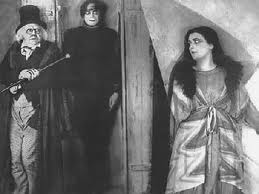
The camera pans between these two scenes as the search for the killer continues. As the tension rises the darker and gloomier the scenes become, with the obvious use of lights to emphasise the atmosphere. In stark contrast Lil’s bedroom is well lit and spacious, with tall angled windows and a sense of calm, but this is short lived when the sleepwalker breaks in and abducts her.
However, her screaming is not in vain, as police and town’s folk follow the Sleepwalker up and across the brightly lit townscape crudely depicted through a simple but effective design that portrays an airy atmosphere managed with the use of lighting, giving a Sin City feel to it. However, the town’s folk are not giving up and continue to chase him until the sleepwalker reaches a oddly depicted bridge where he drops Lil and proceeds to collapse dead in front of her.
“The amazing style of this film first lured me in with its funhouse-feel of its design. A very eerie, stylized funhouse, that is.” The bridge is a typical funhouse scene, which is boldly depicted in a cartoon-like fashion not knowing when shadow ends and exaggerated painting and props begin. While the authorities deal with the sleepwalker, Francis pursues the doctor to an asylum, a large building shrouded in darkness which seems to stand alone in the night. Francis on meeting other doctors at the entrance convinces them to investigate Caligari, who is also the head doctor of the asylum. They find in his office a book on an infamous doctor also named Caligari, who tours the country with his sleepwalker ordering him to prophesy and kill his victims. When the doctors learn of this information they bind Caligari and detain him in the asylum. The film begins to wind down, and still there is no explanation to the meaning behind the crudely drawn child-like cartoon sets and the mood driven atmosphere. “Overall, the plot seems almost stagnant, as if it has nothing new to offer. It seems obvious from early in the film that Caligari is controlling Cesare in order to commit these murders. It’s hardly a surprise when Cesare attacks Jane, the only pretty woman on the screen available for damsel-in-distress duty” This is true, and if not for the twist at the end the outcome of this film would have been much different. The film reverts back to Francis and the stranger in the garden; they begin to walk out of the garden into a square outside the asylum, which looks a lot less intimidating and gloomy, where his betrothed Lil is seated in the middle on a throne surrounded by mental patients. What’s going on? Francis points out the sleepwalker amongst the crowd of patients, but is he not dead? The stranger walks away from Francis with no reply, giving confused glances over his shoulder as he leaves. Francis approaches his betrothed and asks her “will you marry me”, to which she replied “we of royal blood cannot have what the heart wants”. The film becomes clear - Francis is mad, his betrothed Lil is mad also, all the mad people in his tale are really sane, and the sane people, including himself are mad. Fantastic, this explains the reasoning behind the sets, the simplistic but bold re-creation of a mad mans mind using swirls and incoherent lines in his story telling, but when back in reality we start to see straight lines and a more constant use of lighting. The doctor, who turns out to be a reputable practitioner, was being portrayed as the infamous Caligari, a mythical character. A Film worth seeing if not for its vivid depiction of the insane mind, but for the reassuring twist at the end.
Subscribe to:
Posts (Atom)


